2017年12月14日木曜日

Late Autumn in Kyoto | Chocolat BEL AMER Kyoto shop

I really wanted to come to the chocolate shop this time.
It is the Kyoto shop of BEL AMER, which aims for chocolate making to suit Japan and values four seasons, opened two years ago. In fact, Kyoto is the site of fierce competitionamong chocolate shops, coffee shops and bakeries. And Kyoto boasts the largest bread consumption in the country.

I arrived at the shop and found several people were waiting inside the door, so I wondered if it was for entry to the shop but it was for entry to the cafe on the second floor. When entering the shop, a lot of jewel-like chocolates caught my eye. So it was hard to pick but I could get Kyoto-like chocolates not too sweet and with deep taste. I never thought chocolates were such delicious before. I felt very satisfied at the day trip to Kyoto. (H.S) 

            
                              Kyoto style merchant-house-like entrance 

            
                                  I would like to try the cafe next time.
                 They serve afternoon tea, too. 


 There is a tiny garden on the other side of the store curtain.

                  
                                             The shop is busy. 
                   And, it’s very Kyoto-like, there is Shoki (God) on the roof. 


                                    Mizuhiki, instead of a ribbon. 


            “Chocolat Miyabi”
            The design showing four seasons is not only beautiful but also the                          chocolates are all delicious.
            All chocolates are ganache or praline, so you can taste Japanese and
            Western ingredients at the same time.
            Clockwise from top right, strawberry and rosemary, white miso and                      coconuts, brown sugar and coffee, green tea and citron.


2017年12月10日日曜日

Late Autumn in Kyoto | Konkai-Komyoji Temple

Next, I went to Konkai-Kyomyoji Temple for the first time. The temple is one of the head temples of Jhodo sect. The founder of the temple is Honen.
For fans of history in the end of Edo period, it is well known as the headquarters of Shinsengumi (a group of samurai warriors of the shogunate side).
When I came to the temple, I understood why the headquarters was set up there. Because it has a large precinct and is relatively close from Old Imperial Palace. It is said that about 1,000 members were able to station in the temple.
Also, I was right about coming here not overcrowded Nanzenji Temple or Eikando during this time and I could stroll leisurely.
After I reflected on the end of Edo period, I head to Sanjo to buy souvenirs. (H.S)

                        The large abbey can be seen from its eastern slope.

                                    The Amitabha hall and autumn leaves.

           From the stone steps in front the the Founder’s hall to the temple gate.

                                The temple gate and the colored leaves.

                                The stamp of the Konkai-Komyoji Temple.

2017年12月2日土曜日

Late autumn in Kyoto | Seimei-jinja Shrine

The other day I went to Kyoto for the first time in a while. I have visited quite a lot of temples and shrines in Kyoto but still there are ones I have never been to.
So I visited Seimei-jinja Shrine for the first time.
The shrine is famous because it enshrined Abe no Seimei who was a renowned ying-yang master. And it is very popular as expelling evil and a “power spot”.
I also offered prayers and drew a paper fortune which said “lucky”,
so I could leave the shrine feeling refreshed.
Now then, I head to Konkai Komyo-ji Temple. (H.S)

The first gate of the Seimei-jinja Shrine.
           Its crest, a five-rayed star is bright.

In the precincts, there is the actual old Ichijo-modori bashi Bridge,
     which is famous for revival and ghost.

The current Ichijo-modori bashi Bridge close to the Semei-jinja Shrine.
    You cannot feel any nostalgia any longer though.

“Seimei’s well”
         It is said that the water rose by Seimei’s psychic powers.

It is believed that by touching the peach expels evil.
        I also touched it many times :) 

There were wooden boards to write wishes by Yuzuru Hanyu himself.
    Come to think of it, he has performed with a song from the film
    “Yin-Yang Master”.

There was a yin-yang mark on this kind of place in the precincts.


2017年12月1日金曜日

Spreading the charms of Fukui to the world! -Visiting Ichijodani Asakura Clans Ruins Part-7-

As I have introduced in our previous blog, I had the opportunity to join a tour visiting Ichijodani Asakura Clan Ruins in June 2017. I went with the president of the Hotel Riverge Akebono, Mr. Shimizu, the intern of the hotel, Ms. Julia Coslian, the manager of Fukui City Hospitality and Tourism Promotion Office, Mr. Takama and his staff member, Mr. Juancho Santamaria.


The tour spots information of ”Fukui Tour Guides Association (http://fukuitourguides.org/en/english-tourist-spots/ichijodani/)” as follows: Ichijodani is located approximately 10km southeast from Fukui Station. The Warring State-era warlords, the Asakura clan, ruled this area from 1471 to 1574. The ruins of their castle town can still be seen today. In 1971, 278ha including Ichijodani castle was specified for the special historic site of the country. In 1991, the garden of Suwa Mansion ruins, the garden of Yudono ruins, the garden of Asakura Mansion ruins, and the garden of Nanyoji ruins were designated as a special place of scenic beauty. In 2007, 2343 relics excavated from the Asakura clans ruins were designated as important cultural properties.


Ichijodani Asakura Clans Ruins is located in an area that is rich in nature. I think the nature there is one of the attractive parts for its popularity.


As you might have read in our previous blogs that we enjoyed having lunch at the Japanese traditional tempura restaurant, and learning about the Ichijodani Asakura Clan Ruins and Japnaese history in the restored townscape.


Julia experienced Kimono Dressing and she said that she felt as if she had stepped back in time a Warring States Period.


How Mr. Shimizu, Mr. Takama and the guide told us about the stories of Japanese histories were fascinating and enjoyable. I enjoyed listening to them with Julia.


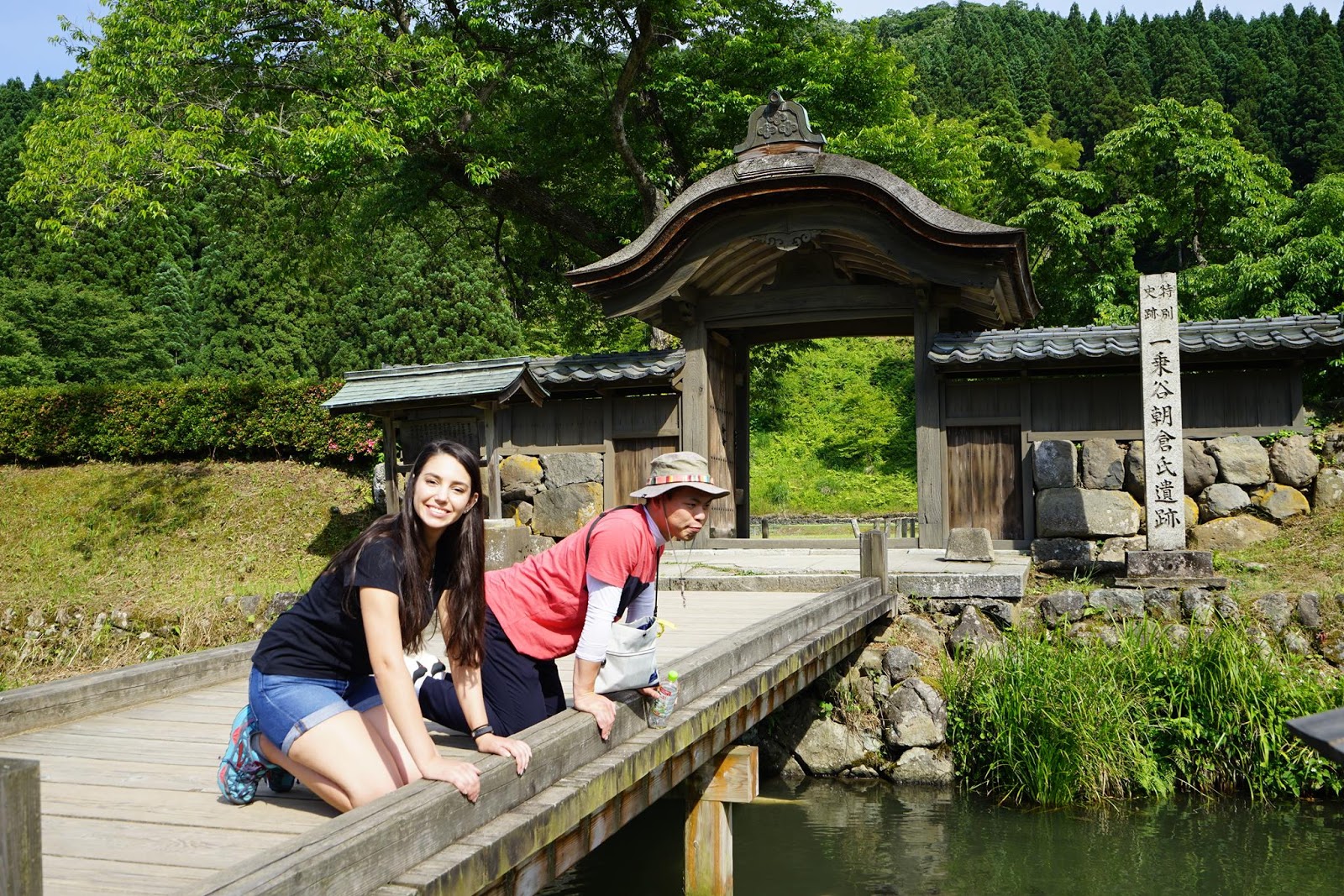
After walking in the restored townscape, we crossed Suwayakata bridge which is located in front of the restored townscape.


The river running under the bridge is the upstream of Ichijodani river.


When they were looking into another stream in front of Karamon gate…


There were beautiful carps and some turtles swimming.


As we were about to walk through the gate and step into the gardens…


we saw a man with a distinguished figure in the armor.


Is he a real warrior?

We decided to go up to him and talk to him.


As soon as we started talking to him, we realized that he is a friendly person. He told us that he is originally from Osaka and he is volunteering at Ichijodani Asakura Clans Ruins because he fell in love with Ichijodani Asakura Clans Ruins. He said that “when I visited here for the first time, even it was my first time being here, I felt that I had been here before. It was very strange feeling but good feeling. It was very nostalgic, comforting and/or soothing feeling. Therefore I decided to move to Fukui. “


Some friends of mine fell in love with Ichijodani Asakura Clans Ruins as well. Whenever they visit Fukui, they always visit Ichijodani Asakura Clans Ruins. There is something about this place that attract people strongly.


Some friends of mine fell in love with Ichijodani Asakura Clans Ruins as well. Whenever they visit Fukui, they always visit Ichijodani Asakura Clans Ruins. There is something about this place that attract people strongly.


Some friends of mine fell in love with Ichijodani Asakura Clans Ruins as well. Whenever they visit Fukui, they always visit Ichijodani Asakura Clans Ruins. There is something about this place that attract people strongly.


T.F


Please enjoy our previous blogs as well.


Spreading the Charms of Fukui to the World! -Visiting Ichijodani Asakura Clan Ruins Part 1-

Spreading the Charms of Fukui to the World! -Visiting Ichijodani Asakura Clan Ruins Part 2-

Spreading the Charms of Fukui to the World! -Visiting Ichijodani Asakura Clan Ruins Part 3-

Spreading the Charms of Fukui to the World! -Visiting Ichijodani Asakura Clan Ruins Part 4-

Spreading the Charms of Fukui to the World! -Visiting Ichijodani Asakura Clan Ruins Part 5-

Spreading the Charms of Fukui to the World! -Visiting Ichijodani Asakura Clan Ruins Part 6-


You can see some tourist attractions and the directions to these places from the webpage, "Hotel Reiverge Akebono, Tourist attractions around our hotel".

Made by Julia during her internship, this webpage has directions that are easy to follow.

She researched these tourist attractions, before visiting them and experiencing

the charms of Fukui herself. As I mentioned in our previous blog, it can be difficult for tourists

to get to some great places in Fukui, so this map that Julia made will help you

get around easier.


There is also a Japanese version of this webpage(only available in Japanese).

However, some of the places which are introduced on the Japanese webpage

are different to the English version that Julia made.

2017年11月29日水曜日

Spreading the Charms of Fukui to the World! -Visiting Ichijodani Asakura Clan Ruins Part-6-

As I have introduced in our previous blog that I visited Ichijodani Asakura Clan Ruins in June 2017 with the president of the Hotel Riverge Akebono, Mr. Shimizu, the intern of the hotel, Ms. Julia Coslian, the manager of Fukui City Hospitality and Tourism Promotion Office, Mr. Takama and his staff member, Mr. Juancho Santamaria.


There are some staff members wearing Kimono standing in front of the restored warrior’s residences, temples, merchant’s houses, craftsman’s houses. If you ask them any questions they’d answer nicely and politely.


Usually, the staff members do not walk with visitors, they stay in front of the places in Ichijodani Asakura Clan Ruins but one of the staff members gave us a special guidance. She showed us around and explained about the history and the things were exhibited. She was very kind and nice from the beginning to the end.


Inside of the restored houses, you can see how people used to live from 1471 to 1573 in the area.


174 Shogi pieces were found outside of the castle in 1973. It was discovered that they were from 1558 to 1570.


During the Warring States Period, people were focusing on making lightweight and high performance armor but Asakura clan made people make the heavy and luxurious ones.


In side of these restored warrior’s residences, temples, merchant’s houses, craftsman’s houses, you can see how things used to be and how people used to live closely. It is enjoyable to see these things imagining how everything used to be. When you have a chance, how about visiting Ichijodani Asakura Clan Ruins.


I’d like to share a video which has been provided by Fukui Prefecture, "Letter of the Fortune: Fukui, home for happiness to come". Ai Takahashi, an actress born in Fukui introduces various places and things including Ichijodani Asakura Clan Ruins. Please enjoy!


T.F


Please enjoy our previous blogs.

Spreading the Charms of Fukui to the World! -Visiting Ichijodani Asakura Clan Ruins Part 1-

Spreading the Charms of Fukui to the World! -Visiting Ichijodani Asakura Clan Ruins Part 2-

Spreading the Charms of Fukui to the World! -Visiting Ichijodani Asakura Clan Ruins Part 3-

Spreading the Charms of Fukui to the World! -Visiting Ichijodani Asakura Clan Ruins Part 4-

Spreading the Charms of Fukui to the World! -Visiting Ichijodani Asakura Clan Ruins Part 5-


You can see some tourist attractions and the directions to these places from the webpage, "Hotel Reiverge Akebono, Tourist attractions around our hotel".

Made by Julia during her internship, this webpage has directions that are easy to follow.

She researched these tourist attractions, before visiting them and experiencing

the charms of Fukui herself. As I mentioned in our blog, it can be difficult for tourists

to get to some great places in Fukui, so this map that Julia made will help you

get around easier.


There is also a Japanese version of this webpage(only available in Japanese).

However, some of the places which are introduced on the Japanese webpage

are different to the English version that Julia made.

2017年11月28日火曜日

Lecture of Mr.Tetsuro Ikema | Why is Japan loved by Asian countries? What should we learn now?

I attended a lecture of Mr.Tetsuro Ikema held at Phoenix Plaza in Fukui City the other day. Here is his profile. 

--------------------------------------------------------------------------------------------
Mr. Ikema was born in Okinawa Prefecture in 1954. He is an active photographer and
a lecturer at Okinawa University. Besides managing a video picture production, he started international cooperation activities in 1987. Currently, he heads a NPO Asia Child Support and supports over ten countries. The activities that he started all by himself but the group has become one of the largest international cooperation groups in Japan and it is highly appreciated. Because he thinks “Loving our country is fundamental for international cooperation”, he continues long-term support against The Great East Japan Earthquake reconstruction and youth development. He hopes that
Japanese people should learn from people trying hard at life of developing countries and
has given lecture at companies, organizations at schools over 3,400 times. 
--------------------------------------------------------------------------------------------
I was moved by each topic he talked, caught up and tears filled my eyes. I’m afraid I cannot introduce the details of his lecture but I will write down partially.

Mr. Ikema met a girl at a dump in Philippine.
He asked her “What is your dream?”
She replied “My dream is living to adulthood.”
Can Japanese children of today understand what she said? 

He strongly advised that you must not over-parenting and doting to your children.
Also, he said “Happiness is the strength of heart that you feel happy. Love must be  accompanied by severity. You don’t need to be liked by your children at all.” 

And he said today’s Japan is unusual condition.
According to Sankei Newspaper, from a survey of high school students,

*Do you respect your teachers?
Other country average 85%
Japan                         21%

*Do you respect your parents?
Other country average  90%
Japan                          25%

Have Japanese children forgotten “respect”?
But Ikema said that it wasn’t childrens’ fault, it was the fault of adults. 

The topics at the lecture covered a wide variety such as the state of Asian countries, a lie of the term “the Age of Discovery”, the true state in white colonies, moral education in Japan before the war, the attack on Pearl Harbor, Japanese soldiers in the operations of Imphal, GHQ, WGIP, justice of the victor countries etc., and I was shocked at the many facts which were not taught in school. I thought that I need to learn more by reading books which review history. (H.S) 


“Don’t worry. I will raise my younger brother.”
It was about twenty years ago, I cannot forget the girl whom I met in Phnom Penh, Cambodia. The girl under the age of ten begged her bread having her younger brother in her arms. She came from the border village of Thailand.
Her parents died. She crawled and begged in the street to survive. She protected her younger brother with her little body. Although I was forty at that time, I felt like a child for myself compared to her. Also, I felt the meaning of life and the severity of life. I was ashamed of myself being sloppy.
(Photo and text are from Tetsuro Ikema’s facebook) 

*Interview with Mr. Ikema (only in Japanese)


2017年11月21日火曜日

Lesser pandas and bowl of rice topped with steak in Sabae City

The other day, I had a lunch in Sabae City. After that, I went to Nishiyama Zoo for the first time in quite a while. For lunch, I had a bowl of rice topped with steak (B lunch) at Grill Sepia. Grill Sepia is a kind of old-style restaurant and has been popular for their meat dishes since long before the recent steak boom began. B lunch is served only from Monday to Saturday and it costs 1,000 yen (exclusive of tax). It is hearty and the meat is tender. They serve extra sauce, so you can add it as desired. It’s delicious and very reasonable price.

A mother and a boy sitting at the table behind me ordered the B lunch too and they were saying happily it was very good. I also felt happy to hear that.

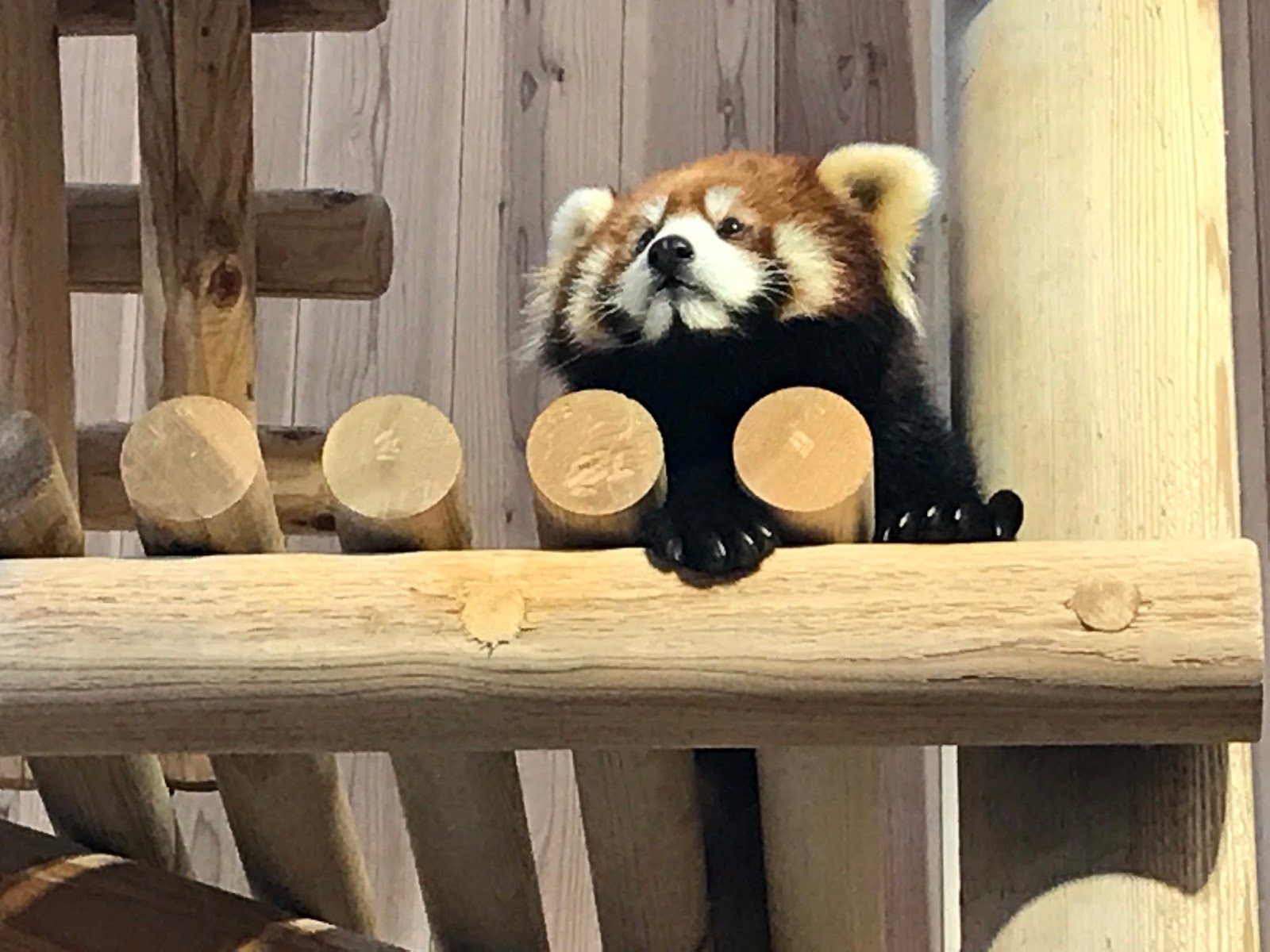
Now, my main purpose of the Nishiyama Zoo is lesser pandas. The zoo has succeeded in breeding lesser pandas most in the country. And admission to the park is free. Of course, all lesser pandas were so cute!

There is a newly-built “Lesser pandas’ house” at the rear of existing panda’s house now. The new house keeps the warm wooden feature. And also there is an outdoor space for them, so the many pandas look relaxed. (H.S)

                    The bowl of rice topped with steak (B lunch) at Grill Sepia.

    Female lesser panda Hikari. Hikari is my favorite panda in the Nishiyama Zoo.

                              Look at the cute Hikari's little bright eyes!

                Male lesser panda YanYan gets a snack from a breeding staff.

                                                YanYan can stand!

                                          Male lesser panda Mutan.
                                   After grooming himself, he grabs his tale.