2017年11月20日月曜日

Spreading the Charms of Fukui to the World! Part-5

As I have introduced in our previous blog, I had the opportunity to join a tour visiting Ichijodani Asakura Clan Ruins in June 2017. I went with the president of the Hotel Riverge Akebono, Mr. Shimizu, the intern of the hotel, Ms. Julia Coslian, the manager of Fukui City Hospitality and Tourism Promotion Office, Mr. Takama and his staff member, Mr. Juancho Santamaria.


At the Ichijodani Asakura Clan Ruins, visitors can experience Kimono Dressing to make them feel as if they have stepped back in time to a Warring States Period.


It was very hot that day, so wearing Kimono would be hard to do. Mr. Takama volunteered to participate in the Kimono Dressing experience.


Julia participated as well. For this Kimono Dressing experience they don’t apply the 'shironuri' makeup (white powder mixed with water into paste) or put a wig, so it gives the participant a natural look. Julia looked amazing.


Before getting dressed up


After getting dressed up


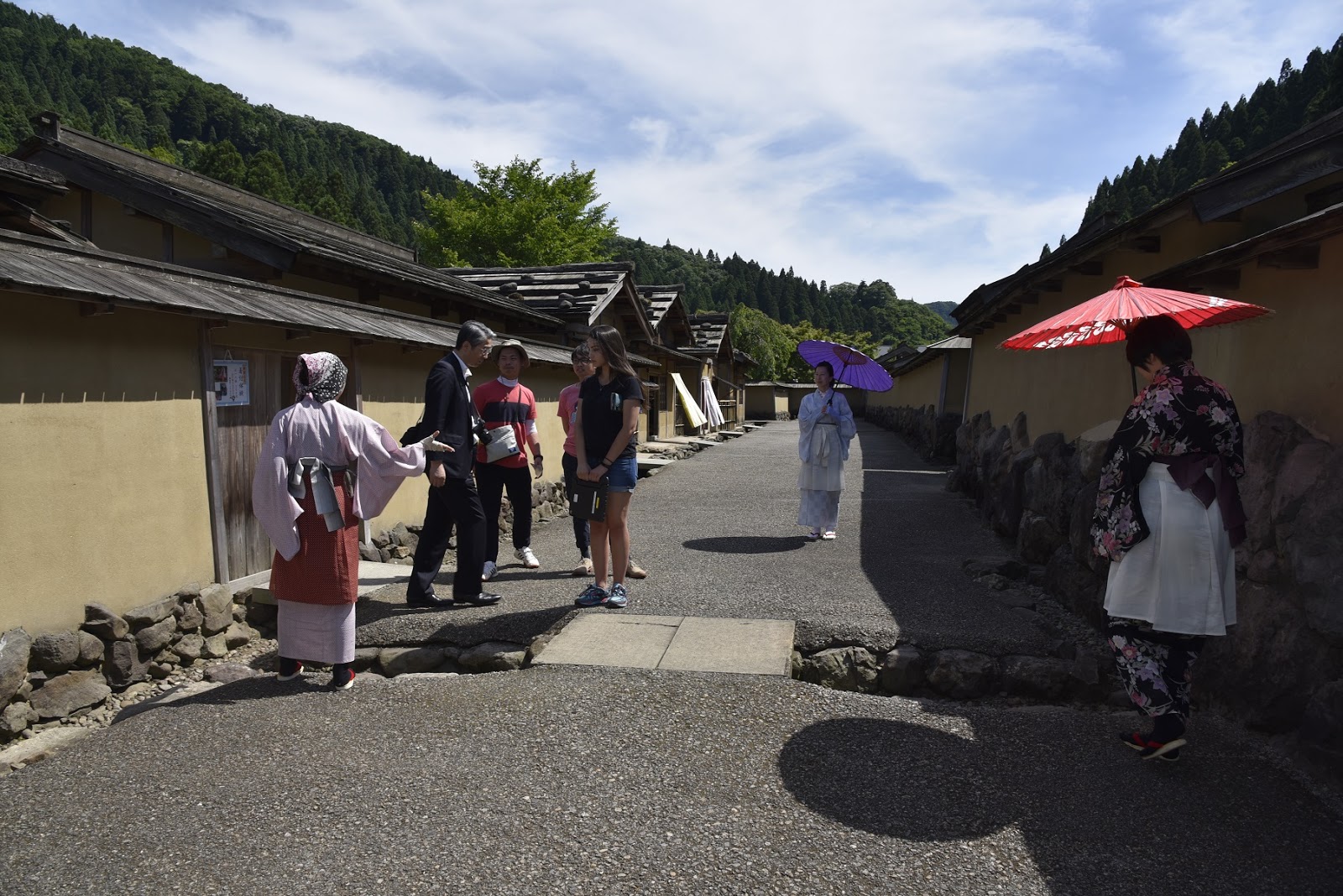
As Mr. Takama and Julia finished getting dressed, they walked through a replica of the town from the end of 15th and 16th centuries. They looked as if they were actually from the time of Warning States Period. The Kimono dress that Julia wore was the one that women from that time would wear when they went out. The armor Mr. Takama wore was what men would wear for fighting. *the Kimono and the armor are not exact replicas of what people used to wear.


As Mr. Takama and Julia finished getting dressed, they walked through a replica of the town from the end of 15th and 16th centuries. They looked as if they were actually from the time of Warning States Period. The Kimono dress that Julia wore was the one that women from that time would wear when they went out. The armor Mr. Takama wore was what men would wear for fighting. *the Kimono and the armor are not exact replicas of what people used to wear.


Julia and Mr. Takama enjoyed walking around in their Kimono and armor as if they were in the time of Warning States Period.


They looked amazing and they also looked like the people from the time of Waring States Period. The Ichijodani Asakura Clan Ruins is located in an area that is rich in nature. Moreover, the buildings were rebuilt as they used to be as accurately as possible so it made us feel that we were not living in modern times.


Other visitors were having fun as well.


Stay tuned for the next blog!


T.F


We would like to share a video which is provided by Fukui Prefecture,

"Japan Emotion in Fukui".

Please enjoy!


You can see some tourist attractions and the directions to these places from the webpage, "Hotel Reiverge Akebono, Tourist attractions around our hotel".

Made by Julia during her internship, this webpage has directions that are easy to follow.

She researched these tourist attractions, before visiting them and experiencing

the charms of Fukui herself. As I mentioned in our blog, it can be difficult for tourists

to get to some great places in Fukui, so this map that Julia made will help you

get around easier.


There is also a Japanese version of this webpage(only available in Japanese).

However, some of the places which are introduced on the Japanese webpage

are different to the English version that Julia made.

2017年11月12日日曜日

“Bunna, come down from the tree” written by Tsutomu Mizukami

Although people think “Bunna” is a children’s book, I think that adults also should read it. When Mizukami was alive, he used to say “If there are novels go down to posterity among my books, they will be only ‘Starvation Strait’ and ‘Bunna’.”

Mizukami reportedly wanted to think about war and peace in the world with mothers and children by writing this book. He also wrote “In this world, all living things and they can live equally under the sun. But this world is where the weak are the victims of the strong. I believe that the horrible, sad and beautiful things that Bunna experienced on the tree make children think and develop to establish self in life.”

In fact, the top of the tree Bunna climbed looked like a paradise first was a food storage for kites.

Bunna’s mother said. “Doing good to others is okay. But you must use good judgement for the other. Some people override good intensions.” Her such words, cruelty of human children and miserable small animals bullied by children or bigger animals tell you inner strength to live.

If you have young children and want to read them something, I recommend “Bunna”. When you read it, I am sure that you enter into the world of Bunna. (H.S)

2017年11月10日金曜日

Spreading the Charms of Fukui to the World! - Visiting Ichijodani Asakura Clan Ruins Part-4-

As I introduced in our previous blog, I had the opportunity to join a tour visiting Ichijodani Asakura Clan Ruins in June 2017. I went with the president of the Hotel Riverge Akebono, Mr. Shimizu, the intern of the hotel, Ms. Julia Coslian, the manager of Fukui City Hospitality and Tourism Promotion Office, Mr. Takama and his staff member, Mr. Juancho Santamaria.


The Ichijodani Asakura Clan Ruins is a large site with a very interesting history. At the information desk, visitors can borrow an iPad to use throughout the area, which shows how things were built during the civil war period in Japan. English versions of the iPads are also available, so visitors from overseas can enjoy this place and its history.


As soon as we walked into the old town, which was reproduced based on the ruins there, so many interesting things caught our eyes and we felt the atmosphere change.


Mr. Shimizu explained to us how and why the town was built in the way they are now. He explained it to us simply so it was very fun and interesting for us to learn about the Ichijodani Asakura Clan Ruins and Japanese history.


For example, when entering the town from the area where enemies would have entered, you can’t see the end of the street.


However, from the end of the street where residents would have lived, they could easily see enemies entering the town. Therefore, the residents were able to prepare for battles. Julia was surprised to see the way the town was built for battle.


Juancho, a Fukui City Hospitality and Tourism Promotion Officer, is fluent in both Japanese and English so he participated in this tour as an interpreter that day. With Juancho and Mr. Shimizu’s explanation in Japanese and English, Julia seemed to enjoy experiencing the Japanese history and knowing about Ichijodani Asakura Clan Ruins.


I myself think it is best to visit actual places like this and not simply read from books or watch TV to understand the charms of such places. I also think that the Fukui accent and dialect, which sound relaxing, are an important part of Fukui’s charm.


More importantly, talking to others with a smile is one of the key values of Japanese “Omotenashi” culture.


DID YOU KNOW?

Although Ichijodani Asakura Clan Ruins has a rich history as the ruins of a feudal lord during a period of brutal civil war in Japan, it has also found fame as the filming location of a commercial for a popular Japanese cellular phone company.

One of the actresses in the commercial is so famous in Japan that she was too busy to participate in the filming of the commercial at the same time as the other actors and actresses. It is little known but the producers actually used a CGI version of her for the commercial! If you have a chance to watch the commercial, see if you can spot which actress is CGI.


Stay tuned for the next blog!


T.F


You can see some tourist attractions and the directions to these places from the webpage, "Hotel Reiverge Akebono, Tourist attractions around our hotel".

Made by Julia during her internship, this webpage has directions that are easy to follow.

She researched these tourist attractions, before visiting them and experiencing

the charms of Fukui herself. As I mentioned in our blog, it can be difficult for tourists

to get to some great places in Fukui, so this map that Julia made will help you

get around easier.


There is also a Japanese version of this webpage(only available in Japanese).

However, some of the places which are introduced on the Japanese webpage

are different to the English version that Julia made.

2017年11月5日日曜日

Handmade pouch present

The other day I received a handmade pouch present from a friend of mine.
I am very happy when I get a handmade present. She has been taken by handicraft recently and enjoys making various items.
The pouch looks easy to put things, so I think it’s good for travel.
For me, a cat-friendly person, the cloth is with a cat pattern.
I like the color too.

Well, what should I put in it?
Just thinking about it makes me fun.
She said that it was quite difficult to sew the cloth into the clasp but it was the beautiful finish.
I have done knitting for a little bit but I have not done handicrafts at all
so I really admire her.
I would like to try handicrafts sometime. (H.S)

                                              Inside cloth is good too.

                                    The yellow one is for another friend.
                                    The red one is for herself.

2017年10月31日火曜日

Spreading the charms of Fukui to the world! -Visiting Ichijodani Asakura Clan Ruins Part-3-

Source: Photographs of the restaurant, “Tempura Yaguruma” from the photo gallery of the official website of Tempura Yaguruma(the website is available only in Japanese)


As I introduced in our last blog, I had opportunity to join a tour visiting Ichijodani Asakura Clan Ruins with the president of the Hotel Riverge Akebono, Mr. Shimizu, and the intern of the hotel, Ms. Julia Coslian, the manager of Fukui City Hospitality and Tourism Promotion Office, Mr. Takama and his staff member, Mr. Juancho Santamaria in June 2017.


Before heading to Ichijodani Asakura Clans Ruins, we had lunch at the tempura restaurant, "Tempura Yaguruma" (the website is available only in Japanese) which is a popular tempura restaurants in Fukui.


Source: Photographs of the restaurant, from the photo gallery of the official website of Tempura Yaguruma(the website is available only in Japanese)


At “Tempura Yaguruma”, you can enjoy watching the traditional Japanese garden with a small waterfall, and the Japanese chef cooking tempura in front of you while you are eating.


There were many foods on the menu that all looked delicious so we couldn’t decide what to order. Mr. Shimizu suggested we order their special lunch combos.


Shortly after we ordered, a lady who works at the restaurant started serving our meals with a lovely and polite smile. First, Miso soup (the taste of the soup was amazing) then, Japanese pickled vegetables and freshly cooked rice were served. It was free refills on the rice. Following that, the tempura was served, which was cooked in the middle of the restaurant where everyone could see the chef prepare it.


As the chef finished cooking, the freshly made tempura, which was crispy and hot, was served for each of us. I loved the crispness of the vegetable, fish and shrimp tempura. The lunch combos were quite substantial. I would like to suggest this lunch combo to people who visit Fukui.


The condiments (or you may call it toppings) are a small plate of grated radish and chopped Welsh onions that are served with the tempura. We call it “Yakumi” and it can be added to your soup or tempura depending on your preference.


Source: dremstime, HOW TO USE CHOPSTICKS


I was amazed by how Julia and Juancho were using chopsticks skillfully and enjoying every meal without any problem. I realized that it is common for people from outside of Asia to be able to use chopsticks well these days.


Source: Photographs of the restaurant, from the photo gallery of the official website of Tempura Yaguruma(the website is available only in Japanese)


Julia and Juancho seemed impressed by the meal and the traditional Japanese garden at the restaurant.


Source: Japanzine Japan’s Must-Read Mgazine, Chopstick Crimes


Source: Hugh FoxⅢ Multicultural Lessons, Japan


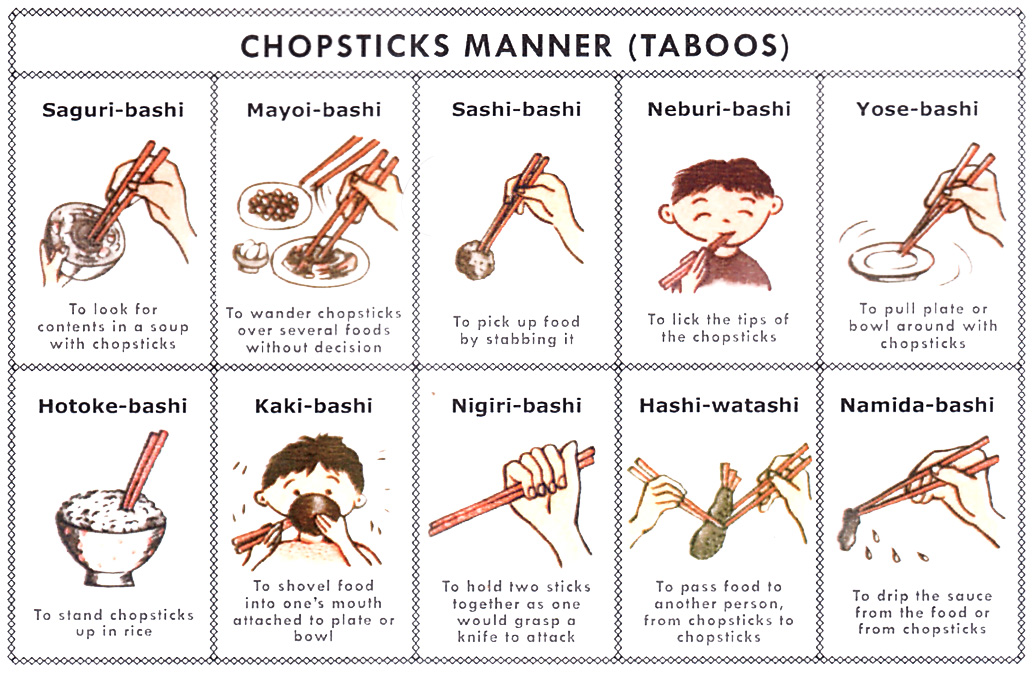
To be able to eat Japanese food in the traditional way, there are many rules and manners one must know. Even some Japanese people find following the rules perfectly a challenge. Julia found it difficult as well. She said that because there is a certain order and etiquette when eating traditional Japanese food, she must watch others to enjoy it to learn properly.


As a Japanese person, I thought I knew how to have traditional Japanese food properly, but I realized that there are rules and manners I am still unsure about such as the order in which to eat, how to hold the bowl for miso soup and everything in between. I would like to properly learn it again to be able to teach others, especially from overseas, the rules, etiquette and the beauty of Japanese food.


Stay tuned for the next blog!


T.F


You can see some tourist attractions and the directions to these places from the webpage, "Hotel Reiverge Akebono, Tourist attractions around our hotel".

Made by Julia during her internship, this webpage has directions that are easy to follow.

She researched these tourist attractions, before visiting them and experiencing

the charms of Fukui herself. I'm sure that this map will help you get around easier.


There is also a Japanese version of this webpage(only available in Japanese).

However, some of the places which are introduced on the Japanese webpage

are different to the English version that Julia made.

2017年10月29日日曜日

Restaurant that you can enjoy Russian food in Fukui City “Soupya”

As autumn deepens, I think you miss hot meals. And I went to the Russian restaurant “Soupya” for the first time in a long time. Probably, it is the only restaurant which serves authentic Russian dishes in Fukui City. I think “Soupya” was located originally in a shopping street close to Katamachi and then moved to the present residential area located on a hill. Even since then, it has been quite some time so you might say it is a long-established restaurant.

Now I arrived at the restaurant, when I was parking my car, presumed its owner came out and guided to park. It was quite dark already and my car has no back monitor, so it was thoughtful.

When I looked at the menu outside the door, I decided B course. Because it includes borscht, piroshki and gryby!

I was guided to a table beside the window and had a quiet meal looking taillights of cars go by below. And I thought that there were few restaurants such a location in Fukui. Recently, the number of cafes along the Echizen Coast have increased but restaurants and bars along a river like in Kyoto or with the evening view, or a stream of cars as a part of view are still few.

So, how about making riverside summer terrace on the Asuwa River bank? Or, how about inviting Starbucks at the foot of Saiwai Bridge like Sanjo-ohashi Bridge in Kyoto? Things unrelated to Russia popped into my head while eating ;) (H.S)

                                        The exterior of the Soupya

                                        Ornaments in the entrance hall

                                               Inside the Soupya

         There were Cheburashka, Putin and Medvedev on the rear wall of my table.

                           Start with borscht. Sour cream adds deep taste.

                             Freshly fried piroshki was soft and delicious.
                             Put mayonnaise or ketchup as desired.

                    Main gryby. You can choose fillings out of several kinds.
                    I chose cheese and mushrooms.

      Dessert and chai. Russian tea is thought to put jam in tea but in fact,                    Russian people put jam in the mouth first and have tea, the owner told me.


2017年10月23日月曜日

Beyond Koshihikari, new brand-name rice Ichihomare grown in Fukui finally unveiled

This autumn, Ichihomare, new brand-name rice which Fukui Prefecture is proud of, was ready for harvest for the first time and its sales started on a trial basis.
Then, I bought and tried it immediately.

When I look it cooked, it was glossy and shining. 
It isn’t need to wait for eating to know that it is delicious. 

Then at last, I had a taste nervously and I felt elastic first. Each grain was soft but firm and had a perfect gummy texture. Also, its delicious taste and sweetness were great. I realized again that rice is such delicious. 

Actually, after I ate Ichihomare, I came to feel that even Koshihikari tasted like something is missing.

In fact, my family grows Koshihikari, but are we going to grow Ichihomare someday? I am looking forward to it. (H.S)

Remarks :
ichi  → the best
homare  honor