ラベル books の投稿を表示しています。 すべての投稿を表示

2020年4月5日日曜日

“English Logically” written by Mitsuyo Arimoto


Her books always have been valuable for me. In particular, “English business e-mail examples” were very useful while there were few good translation services through the Internet.

After graduating from university, Mrs. Arimoto moved to the United States after working for a Japanese company and an American company. She got involved in starting a Japanese company in the United States. After receiving MBA, she became independent and had been active as a strategic alliance consultant between Japanese companies and American ones. Currently, she has been exploring the trend of global economy as an investor. She has lived in the United States for thirty five years. Now she frequently translates and introduces information about coronavirus by overseas media on social media.

She suggests acquiring a technique to convey English logically in this book “English Logically” (2015).

The book says that Japanese people sometimes tend to write incomprehensible English even if grammatically correct;
1. Direct translation
2. Using a complicate sentence to write simple things
3. When using and or but, it’s hard to understand the context because of a leap of logic

Also, many Japanese people misunderstand the meaning of ‘please’, ‘expect’, ‘hope’ and ‘difficult’. For example, you cannot use ‘please’ to your superior, because it is authoritative.

After all, avoiding misunderstandings is necessary first and foremost to write business mails in English. (H.S)

・Get our newsletter

2020年1月12日日曜日

”Clear Your Clutter With FENG SHUI” written by Karen Kingston


The author Karen Kingston was born in England and lived in Bali Island from1990 to 2000. She has studied feng shui and space clearing for many years and pioneered purification of buildings’ energy. The book’s first edition was published in 2002 in Japan, so it is an introduction to clear up things before Konmari comes into the world.

Speaking of feng shui, Trump, now the President, when he built Trump International Hotel and Tower in New York(completed in 1997), he invited a feng shui master from Guandong Province, China and asked advice. 

By the way, according to Oxford English Dictionary, clutter means a lot of things in an untidy state. And, such things that you don’t need influence people negatively as follows.
*Feel tired and lose your energy
*Keep you shackled to the past
*Weaken your body movements
*Tend to delay everything
*Cause disharmony
*Ashamed of yourself
*Slow down development of your life
*Make you feel depressed
*Get desensitized
*Can’t think on what is important

The book also describes as follows.
Here are a few clearing clutter methods that people have tried.  
*Leave it to nature (alias: give up decision). A method that you keep them in a place that they will go rotten naturally.
*Wait until you die, and your relatives get rid of them. This method has been most commonly used for centuries.
*Clear them by yourself responsibly. I suggest this method!
The most difficult thing is that you start clearing. Once you start it, you will be energized quickly, so you will be able to continue naturally.

To be sure, even if I don’t feel like clearing, but once I started, I feel motivated. This year, I would like to make a habit of clearing even one drawer at a time. (H.S) 


                                   Karen Kingston from her official website

 ・Get our newsletter

2019年12月22日日曜日

“A sloping path in Trieste” written by Atsuko Suga


Atsuko Suga (1929-1998) was an essayist and a scholar of Italian literature. When she was young, she lived in Italy for more than ten years, studied Italian language and worked on translation of Italian literature. She married to Italian Giuseppe in 1961 but Giuseppe passed away suddenly several years later and she returned to Japan. After that, she taught at universities.


Trieste, located in the northeastern area of Italy on Italy-Slovenia border, is a port town   with a population of about 200,000. The essay “A sloping path in Trieste” is written about when she visited Trieste alone to trace Italian poet Umberto Saba’s footsteps.


Following are excerpts from the essay.
“No matter how long way to go, I will walk without use of vehicles. It was one of the few self-imposed rules that day. I want to just walk as Saba always walked. “


“Why do I keep attaching my mind to Saba for so many years? Am I trying to overlap memories of my husband who died on a June night twenty years ago?”  


                                   The current book store that Umberto Saba ran.

                              The photo is from a blog:  https://note.com/alberocooking 


Since medieval times, Trieste had been belonged to Austria, but after the First World War, it became Italy’s territory in 1919. Trieste was a peculiar city culturally as well, they had mixed feelings of respect and hatred toward the culture and the people of Vienna. But they continued to admire Italy linguistically and racially. The double nature has made the identity of the people of Trieste complicated. Suga also wrote that the houses in the city were Austrian style rather than Italian.


In Italy, a major tourism destination, Trieste is an unknown, outlying city that affected by history. Suga wrote, “As I walked down a slope, nearby houses looked unexpectedly poor and aging.” And, I also wanted to walk the nameless slope. Suga’s writing style that is quiet, unwavering solid makes me feel nostalgic for the strange city, Trieste. (H.S)


[Video] ETV special | Atsuko Suga-Reminiscence of foggy Italy-Writer who lived in freedom and solitude- Suga’s rare natural voice is from 56’16”


2019年11月14日木曜日

"Japanese's English" written by Mark Petersen

I think that this is one of books English learners should read. A website GEN , which our company runs, also provides English version, so as the person in charge, I am still an English learner. The book's first edition was published in 1988. I thought I once understood the content but I forget gradually, so I should reread sometimes and want to imprint it on my memory. The author Mark Petersen came to Japan in 1980 as a foreign student. Since then, he has studied Japanese literature and now teaches British and American literature and comparative literature as a university professor.


When I first read the book, the part about article was startling. Because I was able to sense its notion directly for the first time. Following are excerpts from the part. 

[ 'a' is not an accessory for nouns]
-The difference between Japanese without article and English that article is the basis of a logical process-
For example, there is a sentence as an opening line as follows.
"Once upon a time, there were an old man and an old woman. The old man…."
In English, they never say, "Once upon a time, there were [the] old man and [the] old woman…" In Japanese, we use "ga" or "wa" as particle that plays the same role as article. When native English speakers speak and write English, noun doesn't give a category of meaning in advance, but presence or absence of article does. 


Come to think of it, sometimes I see native English speakers say like, "I ate a..a...a rice ball." In other words, article comes first and they recall nouns come next. 

As Mr. Petersen wrote in the book, I also feel that English-language education in Japan has not taught the essence of article even though I don't know the current situation. It isn't a bad thing to focus on English conversation and good pronunciation, but I keenly feel the need to learn such a fundamental sense of English first. (H.S) 

2019年11月10日日曜日

"Kyokuyako" written by Yusuke Kakuhata


I read the "Kyokuyako" written by Yusuke Kakuhata, a non-fiction writer and an explorer.


In the Arctic Circle, there is a period called polar night that the sun doesn't rise for many days. This book describes his travel with a dog in the dark for eighty days in detail. He traveled without a sponsor and GPS.

In a TV program, Kakuhata once said, "I feel that adventures and explorations are similar to pilgrimages in religion." "Maybe I want to relive experiences of ancient hunting people." When he said these, his straight eye seemed to have a subtle fear, which might be an awe of nature.

For someone like me who are blessed with the sun for granted every day, the lonely darkness for months was far beyond my understanding. But Kakuhata's clear vocabulary, sensitive depictions of scenes and realistic mental sceneries made me feel fulfillment as if I traveled together with him. His exploration itself was not only stoic, but there were several funny episodes, and he even wrote embarrassing information honestly, which was graceful. While reading the book, I experienced a strange feeling that my main purpose of life is the "exploration" in the book, and other everyday things seemed footnotes to me.

Following are excerpts from the book.
"The dog has quickly become debilitated due to reduced feed and moving along at once. Although it is a dog breed that is resistant to cold weather, it did heavy labor as low as minus 30 degrees C. Its ribs stood out, around its waist got thin, muscles around legs to buttocks were lost entirely. Every time I check it while petting its whole body, I pitied it and I was near to tears."  

As for the descriptions of the dog, it has been like a little dispassionate. But when I read this part at last, I really felt relief because I found that he also had a caring kind side. Meanwhile, Kakuhata tweeted the other day, "I swallowed a gastric camera for the first time. It was painful." I thought he is actually an ordinary person.

Next, I will read another book by him, "Uncharted five miles", which is the records about that Kakuhata challenged world's biggest Tsangpo Grand Canyon in Tibet. His writing is very interesting, so I want to read from one to the next, which is highly addictive. (H.S) 

                          Dog training for next travel to the Arctic Circle
                     The rightmost dog is the one traveled with Kakuhata
                  (The photo is from Kakuhata's Twitter @kakuhatayusuke) 

                                 Kakuhata is making a new sledge.
                (The photo is from Kakuhata's Twitter @kakuhatayusuke) 

[Video] Interview with Yusuke Kakuhata, explorer-Challenge to polar night- (including video clips that Kakuhata himself shot) (11'44") 

2019年8月29日木曜日

"Subarushima" written by Eiichi Ikegami


"Subaru" means gathering, and integrating together. "Shima" means an island.

The writer Eiichi Ikegami raised in Ishigaki Island, Okinawa Prefecture. He is well known for his popular novel "Tempest." The "Subarushima" consists of eight short stories written about each of the eight islands of Okinawa called Yaeyama Islands. All the stories were witty and very interesting, but in particular the story "Iriomote Island" left a deep impression.

I have been to the Iriomote Island three times. The story depicted vividly the island's atmosphere such as the nature like in ancient times, the strong smell of grass in the mountains and the high humidity. So it made me feel like I was in the island again. The storyline beyond my imagination and the depiction of the primitive instinct as male and female were shocking.

Below is from the story's beginning and ending:

-Iriomote Island called "The roof of Yaeyama Islands" is an unexplored region in the southern sea. It is the largest island among the Yaeyama Islands and inhospitable. The high and steep mountains' surfaces always wear cloud veils, so it is impossible to see the whole picture. There are higher mountains than ones in Iriomote Island all over the world. But the mountains in the island are characterized not by their height but by their depth. What you look up at the entrance now is just the tip of the iceberg. As soon as you step inside the mountains and you are in a rainforest that even a compass doesn't work.  

Some young men in mountaineering equipment piled off a boat. A middle-aged man approached them and said, "I study in a lab of this island. Are you, by any chance, going to camp in the mountains?"

The mountains cover over original sin and grow thickly today.- (H.S)


                         A mangrove forest and sands of Urauchi River
                         Nature that doesn't seem like in Japan spreads out. 


                    When I trekked the jungle toward Kampiree Falls, some parts of                                    the trail had become a stream.


           About an hour later, finally I arrived at the Kampiree Falls.
          Kampiree means "place of a god".  Although there wasn't that much of                            height difference, it looked indescribable godly. 


2019年8月6日火曜日

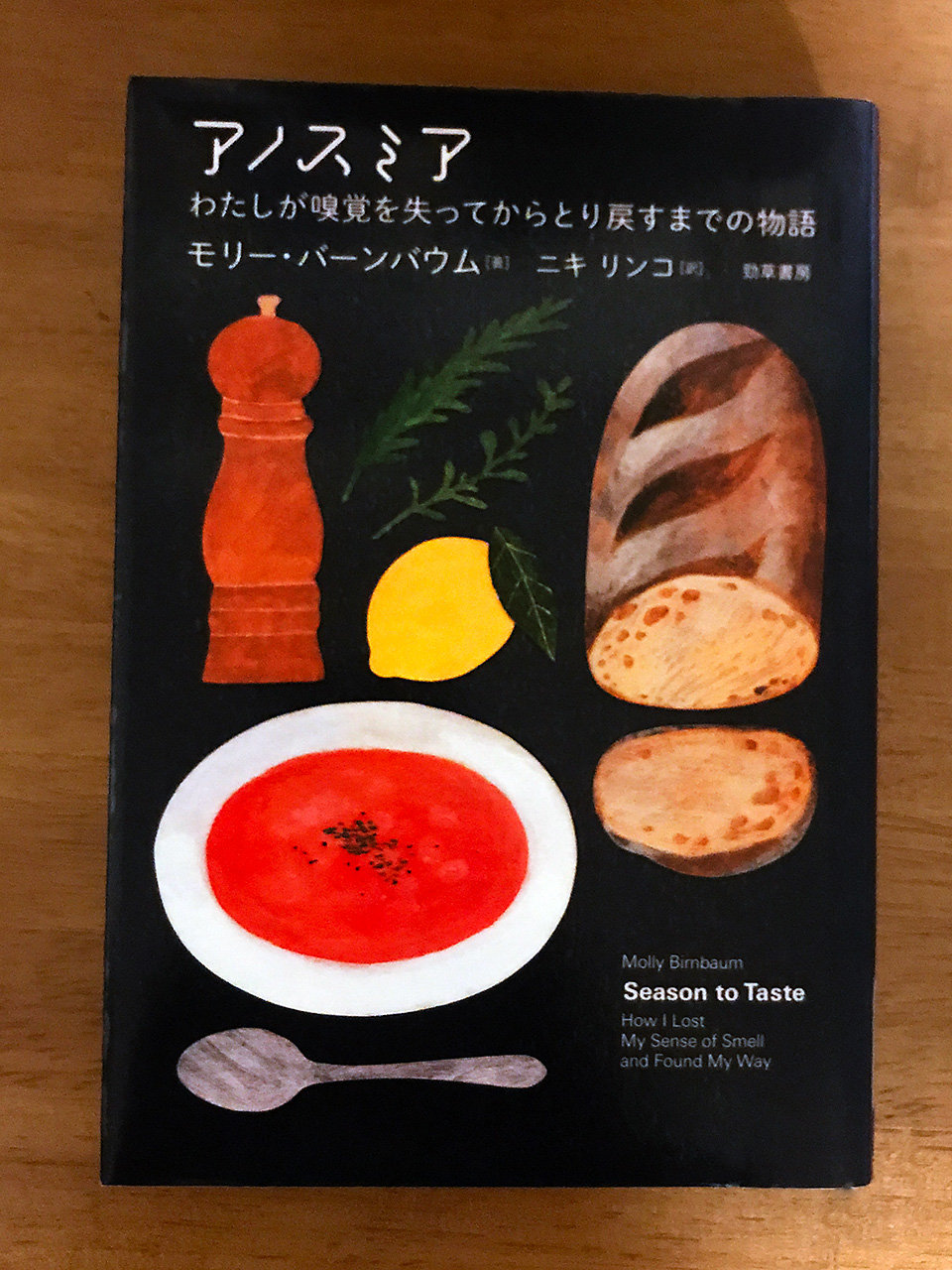
A fresh encounter with a book published six years ago-Molly Birnbaum's "Season to Taste"


It is a story of a young woman who was aiming for a chef, from when she lost a sense of smell until getting it back. I always read electronic books, but since there was no electronic version of the book, I decided to borrow it from a library.

Then I borrowed the book at Fukui Prefectural Library yesterday, and I was surprised that there was no sign that the book was opened because the tassel was folded neatly between the pages of the book.

Am I its first reader? Had it been waiting for being picked up for nearly six years at the bookshelf of the library that many people use? Indeed, the book was published in September 2013.

Having said that, though, the library may not always get books right after publishing, so it didn't make much sense, but it was a bit of fun from the beginning.

I wanted to read this book because it was introduced in the book called "The strongest 'Reading' that is helpful in business" written by a well-known business person and a great reader Haruaki Deguchi. I like the words of him saying, "There is no other way but meeting people, reading books and traveling the world to become smart.”

Mr. Deguchi recommends the "Season to Taste" after mentioning as below.

- "Flowers should have scent, books should have poison." or "An unprejudiced idea is a non-scented bouquet." Among proverbs about books, I like these two irresistibly.-

I have just started reading the book and I do not know at all what the story will be like, but I am curious about what kind of poison or smell it has.
T.S

2019年6月20日木曜日

The 160th Naoki Award-winning novel "Hero's Island" written by Junjo Shindo


The novel's editor says that the manuscript is the best he has ever worked on and recommends it risking his career as an editor. Shindo himself also says that he is so proud of the novel. 

The novel depicts three young people grow in Okinawa after the war with actual persons and incidents. When Kamejiro Senaga appeared in the novel, I cheered, but as for 
horror with the cruelty and outrageousness. 

Throughout the novel, it was like a hot, deep, strong adventure mystery movie. As a matter of fact, Shindo once intended to become a movie director, so that makes sense. I have read several pages every day. It was so much fun to read it and I wanted to read furthermore but even felt it was too nice to finish, and really overwhelming. 

He put Okinawan readings on many words in the novel. I admire that he took the time and trouble to do it despite not being an Okinawan. And, his supplemental remarks were funny and they made me giggle. I like his sense of humor. 

By the way, upcoming June 23rd is the memorial day of Okinawa Prefecture commemorating all who died in the Battle of Okinawa. The day is a public holiday in Okinawa Prefecture. On this occasion, I would like to think deeply about the current situation in Okinawa and the victims' souls. (H.S) 


                    The author's autograph message, and it also says "Please read."  


2019年4月25日木曜日

"Zen: Suggestion for a simple life" written by Shunmyo Masuno

Today, I would like to introduce the book that I always have at hand and am reading again and again. Its author, Shumyo Masuno is a chief priest of a Zen temple Kenkoji and Japan's leading landscape garden designer.

The reason that Masuno is a Zen priest and also started creating gardens is that once Zen monks were going to replace mind attained through practices                something, and one of them were gardens. For example, those who liked a flat surface drew ink paintings.

Masuno says, "Gardens are made of natural materials, so they change continuously, which is called transience in Zen Buddhism. Transience means "not remain". All things in nature change gradually. Changes are our lives and lifetimes. If you don't want to change them, you will have worries and suffer. But if you accept the changes as they are, the worries and suffers won't be them. Gardens are the place that you can realize it. And Japanese people may have tried to find beauty in the changes." 

Below is an excerpt from the book; get rid of unnecessary goods.  

-When things aren't going well, we tend to think that there is something lacking.
However, if you want to change the current situation, letting go is priority than getting something. Remove your obsession, don't assume, reduce your possessions. Living on a simple life means throwing out baggage of body and mind. Letting go or discarding is pretty difficult. As with a separation from someone, sometimes it might be painful. But if you want to get things done smoothly and live lightly, why don't you start by letting go? When you let go, a thing that newly comes is riches.-

It sounds like a contradiction that letting go enriches your life. But probably that means you could elevate to a new level, which gives you strength and mental space.
So I would like to clear up my house during the next Golden Week holidays. (H.S) 

             View of the hotel's garden created by Masuno from the lounge 
             (The photo is from Cerulean Tower Tokyu Hotel's website.) 

                                 The calm atmosphere in the evening 
             
         
 The garden of Gotanjoji Temple in Echizen City, Fukui Prefecture, which is popular as a cat temple, was also created by Masuno.
 (The photo is from Masuno's website as a landscape designer.)

                          There might be the "answer" on the page you opened.