2016年11月24日木曜日

Tasting three-star Wakasa beef that French three-star chef raves!

The other day, I subtitled “Taste of three stars! Wakasa beef” of Fukui Prefecture’s PR TV program, which we release on our video site GEN.
Just around that time, I was given that exact three-star Wakasa beef from an acquaintance.

The differences between common Wakasa beef and three-star Wakasa beef are that the later contains a high amount, more than 55% of olein acid which is a good-tasting ingredient of meat, and it must be under the condition that they are grown in safe and secure raising environment such low-stress raising method.

Olein acid is one of unsaturated fatty acid which is said it is healthy fat that and the main component of olive oil. The more olein acid it contains, the more light and mellow the after taste will be even it is Japanese beef with much marbling.

 The chef, M.Emmanuel Renaut of a three-star restaurant “Flocons de Sel” in France expressed “Its texture and color made a very strong impression. The meat fiber is soft and moist” about the three-star Wakasa beef. Well, so I also tasted that three-star Wakasa beef.  

Since it was quite a large amount, I made “yakiniku bowl” for the first day and “shabu-shabu” for the second day. It was really soft, and the balance of melty taste and fat was very good.
Also, I feel happy to be able to eat in relief because that fat is healthy. (H.S)  


2016年11月23日水曜日

Ideas for Disaster Preparedness / Slippers made of newspaper


This morning, as I was about to listen to the radio which I always listen to every morning, I same announcements in Korean, Chinese and English were repeated over and over again. I didn’t know what was happening at that point. There was an earthquake occurred in Fukushima Prefecture (northeastern Japan) and the announcements were made for evacuation from the Tsunami that was occurred by the earthquake in Fukushima.

That reminded me about the slippers which is made of newspaper. I brought some old newspaper and tried making ones. I still remember how to make them.


Simply put, the picture above is the order for making the slippers. When earthquakes occur, it is extremely dangerous to walk barefoot on floors with broken glasses. Even when there are no shoes around us, with newspapers, we can make these slippers and escape safely. The front parts of the slippers where the most pressure would be put onto has layers of 16 sheets of the newspaper. It’s just the newspaper, but it’s very strong so it makes such a big difference if you have newspaper or not when a disaster occurs.


I learned how to make these slippers during the escaping game called “Experiencing Disaster Preparedness, LIFE LINE” in which the participants played in a team unit at “Mori to Mizuumi no Rakuen” (Paradice of Forest and Lake) whose representative is a Japanese comedian Kuniaki Shimizu near Kawaguchi lake in Yamanashi Prefecture. (T.S)


Mori to Mizuumi no Rakuen (Paradice of Forest and Lake)


Feel Japan / Making Japanese Sake at Kokuryu Brewery / Fukui Prefecture / Rice Planting

The rice which has been planted and harvested by the participants

of “Arigato Project 2016” is now in the process of being made into

the Sake of Arigato at Kokuryu brewery.


On May 3rd, 2016, the opening ceremony and rice planting of

“Arigato Project” of this year were conducted.


On that day, there were storm warning in Fukui City and a gale advisory in Ono City.

In the strong wind the participants and staff of the projects planted each baby rice

with their hands.

Everyone is looking forward to seeing the completed sake next year.


Have you ever experienced planting rice? I stepped into a rice field for the first time.

It was very hard just to take one step that it took more than 20 seconds for me to

walk one step.

Are there any sake breweries in your cities? If you have a chance,

how about experiencing making sake and/or sake brewery tour?


T.F

2016年11月20日日曜日

Report on “Special viewing of the hidden Buddhist statues associated with Great Priest Taicho” bus tour

I accompanied the bus tour “Special viewing of the hidden Buddhist statues associated with Great Priest Taicho” by Echizen Town’s Tourist Federation on November 6th.
Asahi District of Echizen Town, Fukui Prefecture has many temples, shrines and historic sites associated with *Great Priest Taicho, where is a treasure house of Buddhist statues in the Heian and Kamakura Periods. On that day, I was able to see the hidden Buddhist statues especially which have survived from the battles in Period of Warring States and
anti-Buddhism movement in the Meiji Period, and still enshrined by religious belief of local people.
*Great Priest Taicho was born in Fukui City in the Asuka Period(at the end of the seventh century). He was called a child prodigy. When he was eleven years old, he climbed Mt.Ochi, Otanji Temple following the revelation in his dream. After his ascetic practices and mortification, finally he achieved enlightenment of Buddhist teachings.
Afterwards, when he was 36 years old, he opened holy Mt. Hakusan.


Asahi Kannon Fukutsuji Temple Standing statue of wooden Senju Kannon Bosatsu
(Kamaura Period) Cultural Property designated by Fukui Prefecture
The Kannon has eleven-faced small Kannon on its head and forty two hands    

I got a “goshuin” (stamp) at the Fukutsuji Temple.  


Hiyoshi Shrine  Seated statue of wooden Dainichi Nyorai(Heian Period) 
Tangible Cultural Property 
It is rare that there is a statue of Dainichi Nyorai in a shrine. It is said that originally
it was in the Fukutsuji Temple. When the temple opens its hidden Buddhist statues,
more than ten adults carry back the Nyorai to the Fukutsuji Temple. 


Main hall of Mt. Ochi, Otanji Temple , which is one of the oldest temples in Hokuriku Region with a history of 1,300 years. 


Yasaka Shrine  Wooden Juichimen Joshin statue (Heian Period)
Now it is on display at the exhibition “Buddhist statues of Fukui” at Fukui City History
Museum.  


There is a spring named “Life-prolonging water” in the precincts of the Yasaka Shrine
(100 greatest springs in Hokuriku Region) On July 14th,  Gion Festival is held at the shrine in the same manner as Yasaka Shrine in Kyoto. I have heard that it has a nice old-style atmosphere. I would like to see the festival.


                                             The stairs to Joshoji Temple

Tanzan Ueno, the 13th Buddhist priest of the Joshoji Temple, was a leading cultural figure in the late Edo Period.  


                         Nagaya Gate in the precincts of the Joshoji Temple


     As I went out of the Nagaya Gate, beautiful rural view of the village spread 

In the bus tour, there were visitors from other prefectures. A woman from Osaka who joined alone talked that she knew the tour on the internet and there were many un knowing Buddhist statues even in Osaka.
According to Mr.Fujikawa, curator of Fukui City History Museum, the power of Buddhist statues was too strong, so they close the doors and made the statues to hidden ones so that people would not be exposed to the too much power. It was like my eyes were opened for the first time hearing his talk.
The same bus tour is going to be conducted next year again.
How about joining to see hidden Buddhist statues in Fukui and to enjoy a day late in autumn? (H.S) 


2016年11月16日水曜日

-Amazing Japanese Cheering Squads- VENUS / JETS Part-3 -The Finals of All Japan Cheer Dance Championship 2016-

On November 19th, 2016,

one of the greatest adult cheering squad in Japan, "VENUS" which has been formed

by alumnae of Fukui Commercial High School "JETS" (high school cheering squad)

will be in Tokyo for the finals of “All Japan Cheer Dance Championship 2016”

conducted by Japan Cheer Dance Association (JCDA).


We visited VENUS’s rehearsals last month.

They placed a handmade poster that said “16more times”

in front of their rehearsing space while they were rehearsing.

The poster seemed to heighten the momentum toward the championship.

They take their time to stretch and warm up well.


It does not matter if the one who is talking is younger or older.

During their practice, everyone can talk about opinions and/or suggestions comfortably.

When a member talks, others pay attention, listen to the person well and

response nicely with smiles.


They also help each other when anyone has any trouble with their moves.

Most importantly, they all have the same goal which is to win the championship.

They made me realized how important teamwork is.


On that day, they smiled and laughed a lot in a few of those gaps-between-practices.

Being cheerleaders must be hard but their smiles and laughs showed me

how enjoyable to be the ones.

Toward the end of the practice, they had a run-through with the music.

From the beginning to the end they concentrate very hard on their every movement,

facial expression breathing and everything in between.

Right after they finished the run-through, they were running out of breath

and sweating so much that they couldn’t even talk.

I realized that to perform perfectly as they always do,

they put so much more energy, concentration, time and effort than I imagined.


We will visit the "The Finals of All Japan Cheer Dance Championship 2016" on

November 19th, so please stay tuned for upcoming videos and blogs of VENUS!


Also the movie, “Cheer and Dance” in which a few members of VENUS were modeled

will be released in March, 2017.

So this is another thing that we can be looking forward to.

Official Site for the movie "Cheer and Dance"

*Available only in Japanese


T.F

2016年11月13日日曜日

TOEI Kyoto Studio Park|Experience Samurai Movies in Kyoto

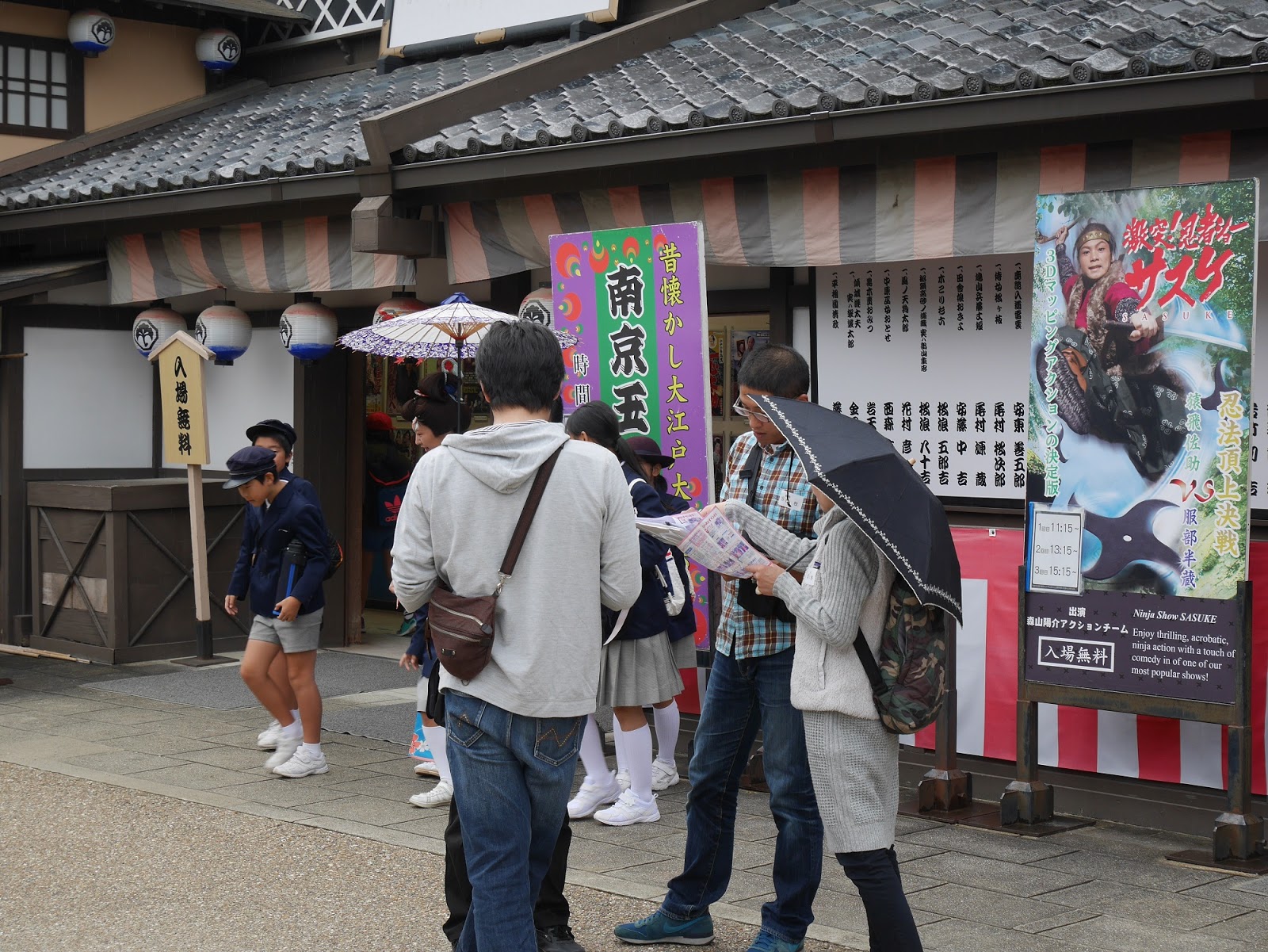
I went to the TOEI Kyoto Studio Park in my company trip at the end of last month. We can choose one among four courses “Lake Biwa and Kyoto|Odaiba|Lake Kawaguchi and Isawa hot springs|Kyoto Studio Park” and I chose the Kyoto Studio Park as I haven’t been there for a long time. This year, each company trip has “Team-building” concept and we tried “Finding buried gold program” by groups. (*This program is only for group tour and you need a reservation.)

And, the program was pretty difficult. If you join the program from now, I strongly suggest that you research beforehand and be flexible in your thinking :) (H.S)


You can meet Ninja there! 


We arrived at the Kyoto Studio Park. In the parking area, there were so many tour buses.
The park was full of elementary students on school excursions. 
There were a lot of foreign tourists as well.


It feels as if time has slipped to back to the Edo Period. 


This is a scenery of period dramas!

It is in the final stage of finding gold. They are working on the last puzzle. 
We arrived a restaurant for lunch. It is ”Rokusei"where is next to Heian Shrine and can be used for wedding receptions.

Their specialty is wooden pail lunch box. The wooden pail box is made by Kiyotsugu Nakgawa, who is a human national treasure. The box is a fine craftwork which is lacquered on the inside. Kyoto cuisine served in it compactly and beautifully is wonderful. They served sashimi and matsutake mushroom steamed dish in an earthware teapot besides this.
Nakagawa's son's studio → Nakagawa Mokkougei Hirakoubou

2016年11月9日水曜日

Sake making experience / Fukui Prefecture  -Arigato Project 2016 began-

The project of making sake from the scratch, “Arigato Project” of this year just started. The participants start making sake by planting rice and they take one year to finish making the sake.

The project has been established since May of 2013 by authorized dealers of Kokuryu, “Yushino Kai” as main members cooperated with Juridical Agricultural Union and Kokuryu brewery.


In one year, through the experience of making sake, the participants learn about sake and the charms of Japan and Fukui.


After one year, the sake, “Arigato Sake” (officinal name is “Kokuryu Adoso”) made from the rice they planted will be completed and ready to be given to the people that they would like to thank to.


Participants are from ages of 20 to 30 who live in Fukui Prefecture.


One of the purposes of this project is to let young people know about “good sake”. According to a staff at Kokuryu brewery The sake which people have for the first time in their lives can influence their perspective and/or image of sake throughout their lives.


I hope that the participants will know the “good sake” and have good times with their family and/or friends.


T.F